Joy of the Just
  • Home
  • About Us
  • Prayers
  • Categories
  • Good Reads

TO WITNESS AND PROCLAIM THE GOSPEL

As Christians, we are all called to priestly and prophetic mission to share and proclaim the Gospel. We hope to share with others the good works of God in our lives and strive towards holiness through Mary and the Dominican Spirituality.
More Info

"By Knowledge & By Love"              Michael S Sherwin OP

8/24/2023

0 Comments

 
                                                                                                           By Br. Dominicus


Certain new theologians dispute original sin, which is the only part of Christian
theology which can really be proved. Some followers of the Reverend R.J.
Campbell, in their almost too fastidious spirituality, admit divine sinlessness,
which they cannot see even in their dreams. But they essentially deny human sin,
which they can see in the street. The strongest saints and the strongest sceptics
alike took positive evil as the starting-point of their argument. If it be true (as it
certainly is) that a man can feel exquisite happiness in skinning a cat, then the
religious philosopher can only draw one of two deductions. He must either deny
the existence of God, as all atheists do; or he must deny the present union between
God and man, as all Christians do. The new theologians seem to think it a highly
rationalistic solution to deny the cat.
G.K. Chesterton, Orthodoxy (1)
Picture
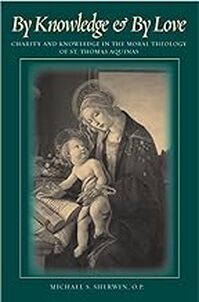
By Knowledge & By Love         
Michael S Sherwin OP, CUA Press, 2005

(Part 1 of 2)
In 1948 Richard Weaver, then a professor at the University of Chicago,
published a little book titled "Ideas Have Consequences." (2) In it, he argued that
ideas that are dreamed up by lonely, intrepid thinkers in small rooms and ivory
towers somehow seem to find their way into people's consciousness. Some ideas
are good, some are bad. Weaver warned that embracing bad ideas leads to, well,
bad consequences.


The ideas that people embrace are often mediated,
changed, vulgarized versions of these notions conceived by some great and not so great
minds. They spread through the media. In the olden days, papers and magazines, then radio
and tv, and these days through the battlefield of social media. They become part of the
cultural atmosphere we live in. If we want to intellectually confront our time, it is
necessary to understand what these ideas - floating around us in the intellectual air
we breathe- are, where they come from, and how to judge them.

The phenomenon that modern ideas seep in and shape debates happens, of
course, also in Church circles. For example, it seems that an idea born in the fever
of existentialist philosophy of the '60s has influenced much of our thinking since
then. This new understanding - maybe better rethinking - of freedom became a
major theme in the discourse of the ‘60s and ‘70s of the previous century. One of
the most famous names connected with this effort was Karl Rahner. He did not see
freedom as part of our created nature, but rather as a transcendental inner space, a
deep self, that needs to be authentically realized. We have to realize and actualize
that self. (3)  Later, this thought was radicalized especially by German thinkers like
Bernard Häring and especially Josef Fuchs. They historicized the self and argued
that because our human life is one of self-realization through an individual
expression of love, no universalizable norms regulate the right practical reasoning
of man. (4)

In a certain sense, this understanding was developed as a reaction against an
approach based on a legalistic view of the moral life that had developed in the
Church based on the casuistry of popular moral manuals (see my post about Pinckaers ).
Trying to live a moral life seemed to boil down to an effort to
determine "the moral status of an act and its degree of merit and sinfulness" built
on a set of rules. (5) Morality was merely a law that restricted freedom. Our job as
humans was to obey that law. The impulse to think that this is too restrictive a view
of morality seems right to me. This type of interpretation of religious life can lead
to "a preoccupation with sin; an almost obsessive concern for law; and myopic
focus on the individual and his or her specific acts. […] But the [C]hristian life is
more than legal observance." (6) However, the move away from a legalistic approach
to one of freedom, authenticity, and conscience was not without consequence. One
does not need to be a Ph.D. in the sociology of the modern Catholic Church to see
that the focus on the individual conscience and the authentic self, in practice, has
meant that almost anything can be considered "good" by any person. And that, at
the same time, caused the notion of sin and the need for forgiveness to disappear.
There is a reason confessionals are empty. The therapeutic mindset of self-
realization took over the idea of sin and forgiveness. After all, the only thing that
matters is that you claim your fundamental orientation toward love and you work
on self -realization. It is hard to escape the impression that we have embraced the
idea that the fundamental Christian command is to love and do what you will, but
then it is emptied of the Augustinian content.  (end Part 1)

(1) G.K. Chesterton, Orthodoxy, Ignatius Press, 1995, P.19. Also available on
https://www.gutenberg.org/cache/epub/130/pg130.html
(2) Richard M. Weaver, Ideas Have Consequences, Chicago, 1984

Blog Joy of the Just 2 of Kees Heesters, 
https://www.joyofthejust.com/home/servais-pinckaers-op-the-sources-of-christian-ethics-cua-press1995


(3) Michael S. Sherwin, O.P., By Knowledge & by Love, CUA Press, 2005. P. 8
(4) Matthew levering, The Abuse of Conscience:A Century of Catholic Moral Theology, Eerdmans,
2021. See Review by Jennifer Frey, Get Real, In First Things, Jan. 2023
(5) Sherwin, P. 3
(6) Idem

0 Comments


Leave a Reply.

    Disclaimer: We hope that you enjoy the content of this website.  We are all journeyers on the road toward heaven and these are some of our thoughts and ideas.  None of us is a religious expert; we hope not to make any egregious errors, and we will try to be as accurate as possible.

    Archives

    April 2024
    November 2023
    October 2023
    August 2023
    July 2023
    June 2023
    April 2023
    September 2022
    June 2022
    April 2022
    February 2021
    November 2020
    October 2020
    August 2020
    June 2020
    April 2020
    March 2020
    February 2020
    January 2020
    December 2019
    November 2019
    October 2019
    September 2019
    August 2019
    July 2019
    June 2019
    May 2019
    April 2019
    March 2019
    February 2019
    January 2019
    December 2018
    October 2018
    August 2018
    July 2018
    June 2018
    May 2018
    April 2018
    March 2018
    February 2018
    January 2018
    December 2017
    November 2017
    October 2017
    September 2017
    August 2017
    July 2017
    June 2017
    April 2017
    March 2017
    February 2017
    January 2017
    December 2016
    November 2016
    October 2016
    September 2016
    August 2016
    July 2016
    June 2016
    May 2016
    April 2016
    March 2016
    February 2016
    January 2016
    December 2015
    November 2015

    Categories

    All
    Fragments Of Faith
    Inspiration
    Living Catholic
    Prayer
    Saints
    The Call

    RSS Feed

Contact Us

Submit
​Joy of the Just - Lay Fraternities of St. Dominic (Eastern Province)
Saints Philip & James Catholic Church & University Parish
2801 North Charles St. Baltimore, MD 21218
  • Home
  • About Us
  • Prayers
  • Categories
  • Good Reads