Joy of the Just
  • Home
  • About Us
  • Prayers
  • Categories
  • Good Reads

TO WITNESS AND PROCLAIM THE GOSPEL

As Christians, we are all called to priestly and prophetic mission to share and proclaim the Gospel. We hope to share with others the good works of God in our lives and strive towards holiness through Mary and the Dominican Spirituality.
More Info

Understanding Aquinas’ Second Way

1/28/2020

0 Comments

 
Picture
                                                                                                              ​                                                                             by    Brother Thomas Aquinas

Near the beginning of the Summa Theologiæ, St. Thomas Aquinas provides five arguments for God’s existence that rely on human reason without recourse to articles of faith or revelation. Since the Summa is by title a summary, Aquinas’ presentation of the “Five Ways” is rather terse, but the philosophical details are clarified in other writings, both by the saint himself and by subsequent authors. Nevertheless, the abbreviated versions are valuable in their own right for one wishing to study the Catholic faith and all it encompasses.
 
In the second of the Five Ways, which we consider here, St. Thomas argues from the principle of causation, and his reasoning may be expressed as follows:

1.  We observe in the world effects brought about by causes.
2.  In some cases, the effect of one cause is itself the cause of a subsequent cause.
3.  Although every effect is the result of some cause, nothing is the cause of itself, for this would require it to precede itself in the order of causation.
4.  In the absence of any particular cause, neither does the corresponding effect occur.
5.  A sequence of causes cannot extend backward infinitely, for then there would be no first cause to bring about any of the others or the ultimate effect.
6.  But we do observe sequences of causes and effects, so there must be a first cause, which we call God.
​
Though many have challenged this argument in varying ways, it is the fifth point that seems to be the least understood. Indeed, there are two different ways to build a sequence of causes and effects, and the distinction between these ways is of crucial importance to the syllogism as a whole.
 
When discussing sequences of causes that may or may not “extend backward infinitely,” there is a strong tendency to envision a sequence that extends backward in time: a line of dominoes falls by successive collisions of one domino into the next. However, these are examples of what metaphysicians call accidental sequences: once a particular cause has produced its effect, it is no longer needed for any subsequent effects. A man can beget a child even though his parents have died. Since any particular cause in an accidental sequence depends upon only the prior cause and is necessary for only the subsequent effect, there is no theoretical reason such a sequence could not extend infinitely far into the past. As long as each domino knocks into the next, the line will continue to fall.
 
Aquinas’ argument fails if the sequences in question are accidentally ordered, but this is not what he had in mind. Instead, the Second Way appeals to essentially ordered sequences of causes. In an essentially ordered sequence, each cause depends from moment to moment on all prior causes, and in fact all causes exist and act simultaneously in a hierarchical structure. For example, an ornate chandelier is suspended above a foyer not only by the first link, to which it is directly connected, but also by every other link in the chain and, ultimately, the fixture on the ceiling. If any link breaks, the chandelier will fall.
 
The utility of this analogy extends even further. Notice that an infinitely long chain is useless to hold the chandelier without the force of a ceiling fixture. Indeed, although each link can be proximally explained by reference to the next higher link, we must eventually reach an agent with its own explanatory power. We achieve nothing by indefinitely deferring such an explanation.
 
The distinction between accidentally and essentially ordered sequences of causes is tantamount to a proper interpretation of Aquinas’ argument. Equally important, however, is the choice of analogy used to illustrate the argument. Therefore, against the multitude of ineffective examples, it will be profitable to identify another that is useful: given an exceptionally long train of boxcars rolling up an incline, we can conclude, even without directly observing it, the existence of a locomotive at the front (or, at least, some external force) that is ultimately responsible for the motion, since boxcars cannot move themselves.
 
It is in this sense—that of boxcars, rather than dominoes—that Aquinas intended his Second Way be read, and doing so establishes the necessity for a first cause, namely God, in order to satisfactorily explain the causes and effects we observe here and now. In fact, since it appeals to essentially ordered sequences, rather than accidentally ordered ones, the argument would be just as effective in a universe that had always existed. And with similar diligence to distinguish the precise meaning of Aquinas’ terminology, there is much to be gleaned from his other writings as well.


0 Comments

Diversity and the Universal Church

1/8/2020

0 Comments

 
Picture
                                                                                                                       By Bro. Raymond Penyfort

Recently, the first Latino to hold the position was elected President of the Conference of Catholic Bishops of the United States, Archbishop Jose Gomez of Los Angeles.  He had served as the Vice President of the organization since 2016. Los Angeles is home to the largest number of Catholics in the United States in one city.  An immigrant from Mexico who is now a US citizen, he is an outspoken advocate for migrant rights.

“I am humbled by your support,” the Archbishop said to the bishops who had gathered in Baltimore for their annual meeting after his election.  “I think it is a special blessing for the Latino community.”  (Wall Street Journal:  Section US Watch, “LA. Archbishop to Lead U.S. Group” November 13, 2019, p. A2) 

It is interesting that this discussion should take place in Baltimore, a city which has a history as an entrance way for thousands of immigrants, many of whom dealt with some of the same struggles and difficulties as have recent arrivals.  For many years, newcomers faced not only a sense of disdain based on class and economic distinction, but out-and-out hostility regarding racial, ethnic and religious affiliations.

Some of these problems still linger on, but there are bright spots.  One I happened to witness more recently occurred in East Baltimore, in the neighborhood of Highlandtown.  I often return to this neighborhood where my family has roots, not only to see the progress that has been occurring but to enjoy patronizing some of the bakeries and stores in the area.  I also have been very impressed to see the recent contributions of Latinos in a number of aspects: new stores, restaurants and markets.

One of the examples of Latino progress has been regarding something near and dear to me and my family:  our old parish Church of the Sacred Heart and its elementary school. Founded and begun by German priests and immigrants, it was always a shining symbol of hard work, sacrifice and pride.  The huge complex and church with its two bell towers with beautiful chimes were symbols of the entire community.

I recall that as older generations died or moved away, there was much concern for Sacred Heart’s Parish.  On one of my recent visits, however, I realized there was no need to worry. It was the Tuesday of Holy Week and I noted the open doors and activity going on around the church.  I wondered and hoped that there wasn’t a problem such as vandalism, whatever. I walked up the long steps and was shocked, surprised and impressed all at the same time. There must have been about fifty or sixty people, all Latinos, men and women, parishioners in work clothes, cleaning, painting and redoing the beautiful floors and statues.  All of the workers, it turned out, were volunteers who came to prepare for the Triduum. They were busy with their work, but some turned and greeted me, then continued working. With the progress that had been made, I could see that Sacred Heart, that magnificent church, had never looked better. I also learned that not only had a number of the religious observances remained, but that in addition, there were new observances and festivals such as Our Lady of Guadalupe and Cinco de Mayo.

Yes, there are still misunderstandings and criticisms and questions from some in the larger community, “Where did they all come from?  Why can’t it remain the same? Can’t they learn English more quickly?” But these reactions are fewer and fewer. As the newcomers have demonstrated their abilities and strengths and have shown that they maintain these same values of family, religion and hard work, more acceptance is occurring.

We are not talking only of the beauty of diversity, but the concepts of the Universal Church.  Most of that community are going to the same church for the same Eucharist and our same Lord is looking down.   Our Lord must be smiling—on the old original community and on the new energetic arrivals as well.

I hope Archbishop Gomez will return to Baltimore and visit Sacred Heart Church.  I’m sure he would be pleased.


0 Comments

Ponderings on the Joyful Mysteries

1/8/2020

0 Comments

 
Picture

​                                                                                                                              
by Sr. Mary Magdalene


The Rosary is a beautiful prayer which is held in high esteem by many Catholics and perhaps, in a particular way, by those in the Dominican Order. Tradition has it that the inspiration for this prayer in its modern form may have come through a visitation of the Blessed Mother to the Order’s founder, Holy Father Dominic.  Over the centuries, this prayer has been held up as a mainstay for Catholic prayer by Popes, religious and laity alike. In the 16th Century, Pope Pius V, himself formed in the Dominican Order, instituted the Rosary and outlined its original mysteries.  Later, Pope Leo XIII, nick named “The Rosary Pope”, wrote several encyclicals expounding on the prayer and its efficacy for the people of God.  Most recently, Pope John Paul II added the Luminous Mysteries and gave us more on the life of Jesus on which to ponder in its prayer.  While we won’t go through the method for praying the Rosary in this blog post, you can find the basic instructions here.
For those familiar with praying The Holy Rosary, you are likely aware of the various mysteries/Gospel moments in the life of Christ and His Blessed Mother and the prayer of contemplation that they are meant to invoke.  They include: The Joyful Mysteries, The Glorious Mysteries, The Sorrowful Mysteries and the Luminous Mysteries. Each set is broken down into 5 separate moments in Scripture or Tradition into which we may enter in prayer and contemplation.  In this blog post, I would like to share some thoughts on The Joyful Mysteries, in particular.
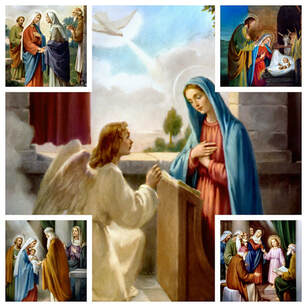
The Joyful Mysteries include a decade of pondering on each of the following moments in time: The Annunciation, The Visitation, The Nativity, The Presentation of Jesus at the Temple, and The Finding of Jesus in the Temple.
Recently, while I was praying these mysteries, it struck me that each of these moments of contemplation revealed a kind of “recognizing God” in the encounter.  It is this that I would like to focus on. I encourage you to read the related scripture references in the citations and ponder them for yourselves!
Let’s start at the beginning with The Annunciation (Lk 1:26-38).  In her humility, the Virgin Mary both recognizes and welcomes God’s call through the Angel Gabriel.  Her soul was holy and sensitive enough to know and heed the voice of God.  Mary responds wholly and without reservation, “be it done unto me according to your will.” (Lk 1:38)  How do we “hear”, or recognize God in our own lives? We are assured in both this passage from Luke as well as in another in John, when Jesus says “my sheep know my voice” (Jn 10:27) that it is possible!  How does anyone recognize the voice of another? Perhaps the answer lies most readily in time spent with another…..listening…..and internalizing their words, their voice, their love and care for us.  Mary recognized God, and so can we.
The second Joyful Mystery is The Visitation (Lk 1:39-56).  In this encounter we are told of Mary’s reaching out to her kinswoman, Elizabeth.  Again we are met with a couple of moments of recognition. In Lk 1:41-42 we hear that upon Mary’s greeting, the child Elizabeth was carrying “leaped in her womb”.  The unborn child, later known to us as John the Baptist, recognized the presence of his Lord Jesus and ‘leaped’.  In response, Elizabeth “filled with the Holy Spirit, cried out in a loud voice and said, ‘Most blessed are you among women, and blessed is the fruit of your womb.’”   Elizabeth and her unborn child, John, recognized and responded to the presence of God among them and Mary responds with her Magnificat, always pointing us back to God.
The third Joyful Mystery is The Nativity (Lk 2:1-20).  Of course we see and hear so much of this familiar event all around us in Scripture, Carols and Tradition.  The Angel and the Heavenly Host proclaim to the shepherds the birth of the Savior child. They hear, they recognize the voice of God through the angels and they are drawn to find and adore the infant, Jesus.  In Mt 2:9-11 we hear about the Magi and how they saw and recognized the star, following it to Bethlehem in order that they might bring gifts and worship the newborn king.  We are told that when they saw the infant Jesus with his mother, Mary, they “prostrated themselves and did him homage”, recognizing Jesus as God among them.
The fourth is The Presentation of Jesus at the Temple (Lk 2:22-38).  In this account we encounter a wonderful moment of recognition in which Simeon, a “righteous and devout man” takes the infant Jesus into his arms and proclaims “Now, Master, you may let your servant go in peace, according to your word, for my eyes have seen your salvation which you prepared in the sight of all the peoples, a light for revelation to the Gentiles, and glory for your people Israel.”  Simeon has seen God and is now prepared to die with a happy heart. The prophetess, Anna, likewise recognizes and proclaims Jesus as Lord, speaking “to all who were awaiting the redemption of Jerusalem.”
The fifth and final of the Joyful Mysteries is The Finding of Jesus in the Temple (Lk 2:41-52).  Here we hear the familiar story of the time that Mary and Joseph lost track of the 12 year old boy Jesus!  They had gone to Jerusalem for the celebration of Passover and as they headed back home with the crowds, they hadn’t realized that Jesus had remained behind.  They eventually found him in the temple speaking and asking questions of the teachers, and “all who heard him were astounded at his understanding and his answers.”  They recognized the wisdom of God in the words of this boy.  Later in the encounter, we hear Jesus himself with a moment of recognition, “Why were you looking for me?  Did you not know that I must be in my father’s house?”
Throughout The Joyful Mysteries we walk through a great depth of scripture with the power, by Grace, to bring us to greater understanding, encounter and love.  In one of those moments, I encountered the ribbon of recognition of and hopefully response to the voice, the word, of God.  May we all strive to spend time with the Lord, learning to hear His voice, recognizing Him in people and places and moments of prayer and sharing the fruits of that encounter.


0 Comments
    Disclaimer: We hope that you enjoy the content of this website.  We are all journeyers on the road toward heaven and these are some of our thoughts and ideas.  None of us is a religious expert; we hope not to make any egregious errors, and we will try to be as accurate as possible.

    Archives

    April 2024
    November 2023
    October 2023
    August 2023
    July 2023
    June 2023
    April 2023
    September 2022
    June 2022
    April 2022
    February 2021
    November 2020
    October 2020
    August 2020
    June 2020
    April 2020
    March 2020
    February 2020
    January 2020
    December 2019
    November 2019
    October 2019
    September 2019
    August 2019
    July 2019
    June 2019
    May 2019
    April 2019
    March 2019
    February 2019
    January 2019
    December 2018
    October 2018
    August 2018
    July 2018
    June 2018
    May 2018
    April 2018
    March 2018
    February 2018
    January 2018
    December 2017
    November 2017
    October 2017
    September 2017
    August 2017
    July 2017
    June 2017
    April 2017
    March 2017
    February 2017
    January 2017
    December 2016
    November 2016
    October 2016
    September 2016
    August 2016
    July 2016
    June 2016
    May 2016
    April 2016
    March 2016
    February 2016
    January 2016
    December 2015
    November 2015

    Categories

    All
    Fragments Of Faith
    Inspiration
    Living Catholic
    Prayer
    Saints
    The Call

    RSS Feed

Contact Us

Submit
​Joy of the Just - Lay Fraternities of St. Dominic (Eastern Province)
Saints Philip & James Catholic Church & University Parish
2801 North Charles St. Baltimore, MD 21218
  • Home
  • About Us
  • Prayers
  • Categories
  • Good Reads